Monday, July 21, 2014

Reflections on Race

“If I didn’t feel so guilty about being white I would…be better able to teach my kids about racism.”

The words left my mouth before I realized I had formed the sentence. We were three weeks into our Eliminating White Racism class, and my discussion partner gave me an empathetic nod. As someone who doesn’t usually speak without knowing exactly what I mean to say, the words surprised me. I wasn’t aware that was roaming around my brain. Was that really how I felt? Three weeks ago I was apprehensive about starting this class at all, and now I was blurting out subconscious concerns.

Walking into the first class, I wondered how the weeks would unfold. Would there be lectures? Would we be asked to recall every instance we had ever had or experienced a racist thought, feeling or expression? As someone who has studied culture, race and gender across history, I could call to mind no shortage of occasions where my culture had dominated, repressed, rejected, minimized, shamed and even destroyed other cultures. I was not looking forward to a rundown 2 hours a week for the rest of the spring and early summer. Instead, I discovered a safe space meant for examining my own experiences, my own guilt as a result of unearned privileges based on something as uncontrollable as my skin color and, yes, my own racism.

Given the YWCA’s mission to eliminate racism, holding an internal Eliminating White Racism training is a fantastic way to get all of our staff on the same page. I think being immersed in this work that it can be very tempting to think we’ve got this under control; that we recognize racism when we see it- even our own. Having a reminder of all the forms racism can take whether overt or subtle, deliberate or unintended, internal or external helped to reinforce that all of us are participants in this struggle to end racism. Sometimes it’s not glamorous. Sometimes it’s as small as examining your own thoughts and calling yourself out on them, because the fight to end racism has to start somewhere.

Posted by E'lise Chard, YWCA Missoula Office Manager


Thursday, July 17, 2014

Moving On...

Twelve months ago, I began my service as an AmeriCorps VISTA at YWCA Missoula, and I must say, this year has been one of the most rewarding I've ever had. Before VISTA, I had been involved with the YWCA as an intern and volunteer, but my passion and commitment to the mission of the YWCA really grew to a new level this past year.  For my VISTA project I was placed with the Transitional Housing Program, which provides housing and supportive services to homeless survivors of domestic and sexual Violence. Throughout my term, I worked on various projects to help improve the housing programs, educate the community, and provide services to the participants we work with. One of my most proud and influential projects was the work I did to improve our database. This database not only helps us track the participants in our programs, but it is integral to our ability to accurately produce reports for grants. Through the efforts of myself and the past two year's of VISTAs we were able to get this tool in place and backlog the information for the past two years!

In addition to my work on the database, I was also able to help with some of the day-to-day operations of the Transitional Housing program. This experience really opened my eyes to the high rates of domestic violence that exist in our community, and how much it contributes to the social issues of poverty and homelessness. Compared to many places in Montana, Missoula has a fair amount of resources to help these individuals and families, but it never seems like it's enough. We, as a community, still have a lot of work to do around these issues. 

I have grown an immense amount and learned so much since entering this program. My passion for working in human services has really deepened and I am proud to say that I will continue with this work after the completion of my term-- this time,  as the coordinator for the YWCA Rapid Re-Housing Program, which is set to launch in early September.  I look forward to helping homeless families find housing and provide support to help people overcome their barriers.

While I am deeply committed to work of the YWCA, my favorite thing about this organization is ladies that I get to work with. The staff here is so supportive and spends their days trying to make things easier for their fellow community members. I feel motivated and inspired by my co-workers all of the time, and feel so grateful to have the opportunity to continue to work with these amazing people.

Posted by Miranda Sanderson, AmeriCorps VISTA with the Transitional Housing Program


Pictured: YWCA Missoula AmeriCorps VISTA members Miranda and Maura.

Friday, June 20, 2014

Reflections: A Year at Gateway

I am a student with the Masters in Social Work program, (MSW), at the University of Montana.  My practicum placement this year was with the Ada’s Place Gateway/Emergency Housing program.  The program helps homeless families with a stay in a motel and offers case management services to aid in finding housing, employment, and other services as needed.  I also advocate for clients in other areas of their lives if they need help.  This type of work was all new to me.  I am from a small town where everybody knows everybody and if you need a place to stay you can “couch surf” until you find a place of your own. Growing up I did not know what homelessness meant.  My family was not well off, but we had food and shelter.  I remember my uncle coming to stay with us when he was in town, but he was more of a drifter than actually homeless.  My work history involves waitressing/bartending, working with developmentally disabled individuals, and being a Juvenile Correctional Officer.  All these jobs and a Bachelors degree in Psychology did not prepare me for what I experienced while working at the YWCA. 

Missoula is a beautiful place to be.  There are more services for the homeless here than any other city in Montana.  I had a hard time finding a place when I moved here, but luckily I found one.  There are many here who do not have a place to live.  The stereotype of all homeless people being drunk, lazy, or mentally ill is completely not true.  My short time at the YWCA taught me that.  I see people every week that have jobs, go to school, or are in the process of both that are homeless.  The circumstances with each family are different but, they are not the stereotype that people tend to think of when “homeless” enters their mind. 


Right now, there are numerous people on the waiting list for Emergency Housing.  The big problem seems to be coming up with first and last month’s rent and deposit, all at one time. Many of these homeless families are sleeping in their cars or camping where they can find a place because there are no free places in town to camp or park a car to sleep in.  These are just a few of the issues homeless families have to deal with.  The YWCA and other service providers in town do what they can, but here is not enough funding to go around but much more is needed to better meet the needs of these families.  However, you can help us! Donations of camping gear like: tents, sleeping bags (for adults and children), blankets, or anything else camping-related can help homeless families in a time of great need. The people who use our services are grateful for any help you can give.  Thank you all for everything you do.  

Posted by Dana Beardslee, Gateway Assessment Center Practicum Student

Tuesday, May 27, 2014

YWTalks: A Community Social Justice Series Wrap-Up

Well folks, the YW Talks: Community Social Justice Series has coming to an end. It has been a wonderful season this year with a combination of men and women speakers addressing social justice issues that are pertinent to women and those of diverse ethnic backgrounds. We also changed the name of our series from the “YWCA Brown Bag Lectures Series” to the new “YW Talks.” Why did we change the name you ask? Turns out the term “Brown Bag” has a negative association attached to it and here is why:

A “test”, which had the common use in the early 1900s among upper class Black Americans and families, was used to determine if a Black person was “white” enough to gain admittance or acceptance. If your skin was darker than a brown paper bag, you were not valued or included. Thousands of Black institutions and schools including the nation's most well-known Black fraternity, Phi Alpha Phi at Howard University, practiced this discrimination. As an organization that has a racial justice initiative incorporated in its mission, we were not interested in supporting this term any longer by using it in the title of our community lecture series.


I have really enjoyed being the coordinator for YW Talks: Community Social Justice Lecture Series this year. It has been a pleasure engaging with Missoulians who present on such important topics and create a space for dialogue and discussion for our community members. I hope that this series continues to grow and expand as a predominant piece in creating social justice in our community and even on the larger scale.

Our presenters for this season included:

September: Anisa Goforth: Arab American Students

October: Helga Hosford: Personal experience in Nazi Germany

November: Tobin Shearer: Iceberg Theory to Racism

December: Phyllis Ngai: Intercultural Communication and Social Justice

January- Anya Jabour: Women’s History and Racial Justice

February-Ruth Vanita: Hindu Goddesses

March-Mehrdad Kia: Islam and the West

April-Amber Gladney: Peace Corps experience in Africa

May-Suzette Dessault: Women’s Suffrage in Montana


Posted by Miranda, Transitional Housing VISTA

Monday, April 14, 2014

Fight For Hope and Freedom: Human Trafficking, Montana & the World


EVENT ANNOUNCEMENT: University of Montana Mansfield Center Conference on Human Trafficking: “Fight for Hope & Freedom – Human Trafficking, Montana and the World”
April 16th and 17th  at the University Center – FREE ADMISSION

Human Trafficking is modern day slavery exploiting an estimated 30 million people worldwide. More people are living in slavery now than at any other given point in history! Human Trafficking is a high-profit, low-risk crime and the fastest growing industry in the world after the drug trade. Trafficking is no longer a crime that happens only in the brothels of Thailand and other South-East Asian countries. In fact, it has become one of the most serious human rights and social justice issues of our time, impacting foreign nationals and U.S. citizens alike. However, many people believe that labor and sex trafficking doesn't happen in North America and especially not in Montana – we only see what our eyes are trained to see, right? – and consequently, misinformation and missing information governs our laws, funding options, and services available to survivors. We call it “prostitution” and like to think that women voluntarily engage in sex for money; since prostitution is illegal, the girls and women are often arrested, while the “Johns” get a slap on the wrist, turn around, and find the next vulnerable woman on the internet.

We are seeing a rapidly increasing number of survivors of sex and labor trafficking in the United States, including the Big Sky country of Montana. In 2012, the Polaris Project, the leading Anti-Trafficking NGO in the US, reported a total of 20,652 calls on their crisis line – 34 of those calls came from Montana. Minor girls are being advertised on online sites like Backpage.com. We see examples like the “boyfriend- turned-pimp” who forces a runaway teen to engage in sexual acts in exchange for a roof over her head, food, and the “true love she has never known.” Cases like this point to another sad fact: the majority of both children and adult women that end up in the sex industry, were victims of child sexual abuse prior to “recruitment.” We are talking about an industry that targets people that have been victims of trauma; an industry that preys on the most vulnerable and marginalized people in our society.

As a society, a community, and as fellow humans, we have a responsibility to address this social injustice  and ensure safety, support, proper resources and overall justice for the many women & girls, men & boys across the U.S. and worldwide who are being forced into slavery. This also means that we have to strive to be proactive and address the root causes and larger systemic issues behind the problem – gender-based violence, equal opportunities for all young people, the impact of racism in our society and much more. The first step of this process is raising awareness through education so we all have the tools to identify and respond when we see potential red flags of trafficking in our communities. This year’s Mansfield Center Conference promises to deliver just that, by convening  leading international and national experts in Missoula to address this challenging topic. I hope to see many of you there so we can move forward and fight to end human trafficking together!


Full agenda and registration info here: http://www.umt.edu/mansfield/events/conference/

Posted by Kat Werner, YWCA Pathways Program Manager

Friday, March 28, 2014

Reflections On Race and Reading

             When I was a kid I loved to read so much that my mom would ground me from reading the way other parents would ground their kids from TV. I had to have a book EVERYWHERE I went, even the supermarket. This reading addiction, while not always beneficial to social interaction, was beneficial for my future as a “thinker and a doer” in society. Of all the skills I learned from reading, the ability to empathize with a character and truly put myself in their shoes was the most important.
            Recently while reflecting on these early childhood experiences with books, a thought popped into my head. Would a little girl of a different color than me have had the same experience? Would a little girl, like me in every way but color, have had the same plethora of stories to identify with and dive into?  Growing up I read a lot of books about girls in different cultures and of different races, but how might my experience have been different if I had been born outside the dominant culture?
            With this thought in mind, I decided to take a field trip to the Missoula Public Library. After accruing my usual too-tall stack of books, I headed to the children’s section. I began pulling books off the shelves at random and looked at the illustrations. I only spent about half an hour reading (I was getting the stink eye from a little boy eyeing my spot on the couch), but it was enough time for me to notice something. The number of books with a person of color in them was pretty darn low. The books with animals as characters had more diversity than most of the books with people in them.
            That’s not to say there weren't some stories about, and including people of color, but the point is that there weren't as many as there should be to accurately reflect the reality of the world (fictional or not). This isn't an intentional omission on the part of the library, it’s a symptom of a greater system at work, Portions of our population are being left out of the literature we are using to inspire our children and young adults (this coming from a youngish adult herself).
            The more I thought about it, the more I realized that most of the books I pick up in the young adult section of the library don’t have a whole lot of characters of color. If you take a second to think of some of the most popular young adult novels out there, you might notice that most of them center on white heroes and heroines. For example on NPR’s list of the 100 best-ever teen novels, of the top five books listed, none have a main protagonist who isn't white. To Kill A Mockingbird is the only book in the top five that directly deals with race.
Under representation of minorities is in no way new or surprising, but my little field trip to the library got me thinking. What’s causing this under representation in the literary world? Is it the lack of writers of color? Is it a lack of white authors being interested in, or accurately writing stories about people of color? Is it a lack of an audience? Are writers of color not being encouraged? What’s the deal? Male writers write about females. Female writers write about men. White people obviously have no problem writing in supporting characters of color, so why is there an absence of main characters who are different colors? Personally, I think that when the majority of writers sit down to write, they either write what they know, or they write what they wish they knew, and somewhere in there, racial diversity in characters is getting left out.
            Reading is supposed to be an immersive experience. It is an activity which is solely dedicated to understanding the thoughts and feelings of other people, their motivations and their desires, what makes them who they are as a human being. Books can have huge ramifications in society; they are a pulse point of modern society’s concerns and cares.
            In order for our society to grow we have to expand the diversity of our literature. I don’t mean that we need more niche books specifically about race. I mean that we should have more books that reflect the complexity and diversity of our society. As long as people of color remain underrepresented in the literary world, our children and young people are facing yet another arena in which racial diversity looks like a token book here and there, not the status quo.
            At this point, as in many of my blogs, I am left with a question. What can I personally do? I think the first step is to highlight the literature that’s already out there that is inclusive. So here’s where I ask for your help. What recommendations do you have for reading? What books do you read to your kids that encourage racially sensitive thinking? Let’s compile a starter reading list, so that we’re all a little better informed about the books which not only entertain us, but make us more socially conscious people as well. 

----
Related Information:
YWCA Missoula is excited to announce that the University of Montana will be holding a conference on race and creative writing on April 10. 

"The goal of the conference is to address the relative paucity of discussions on the topic of race and creative writing in the academy in general. The panels and readings will bring to the discipline and teaching of creative writing perspectives from critical race theory, poetics, performance studies, literary theory, ethnic literature, and Native American and Indigenous studies."

For more information about the conference click here.

Posted by Juliana Rose, YWCA Missoula Racial Justice Intern

Tuesday, March 11, 2014

Pet Advocates Ease Transition for Domestic Violence Survivors

Samantha and Roxy had been the best of friends since Roxy was little.  Everywhere Samantha went, Roxy went.  Everything Samantha did, Roxy did.  Samantha would confide in Roxy, cuddle with Roxy, and enjoy comfort and support from Roxy.  Roxy was Samantha’s 70lb black lab whom she had raised since she was a puppy.  Roxy was 6 years old when Samantha moved in with her boyfriend, Rick.  It didn’t take long for the abuse to start and often it was directed toward Roxy.  When Samantha was ready to leave the relationship, she called the crisis line to inquire about emergency shelter.  She was informed that she could not have Roxy at the shelter.  Samantha hung up the phone and cried.  She was now faced with the decision to leave Roxy behind, risking more harm or even death to Roxy, or to stay in the relationship to be with Roxy and protect her from the abuse.

Imagine being faced with this decision.  Imagine having to leave your best friend behind.  Roxy had been Samantha’s comfort and support her entire life and especially during the abusive relationship.  Unfortunately, pets are often used as pawns in abusive relationships.  Abusing the survivor’s pet is another way for the abuser to manipulate or threaten the survivor and gain power and control.  Survivors often delay leaving an abusive relationship if they cannot take their pet with them, or find a safe place to keep their pet.

This is why the YWCA created the Pet Advocate program.  The Pet Advocate program provides foster homes for pets of survivors staying at our domestic violence shelter.  By providing these foster homes, we can remove one more barrier for people looking to leave an abusive relationship and offer the survivor peace of mind, knowing that their pet is safe.  Pets offer a special type of love and comfort to their owners, and it is our goal to help survivors keep their pets.

Pet Advocates are volunteers who have gone through training to learn about the complex relationship of pets and domestic violence,  and the unique characteristics of caring for pets who may have been abused.  These amazing volunteers open their homes and hearts up to these pets and love them as if they were their own.  The YWCA partners with the Humane Society of Western Montana, who provides food, vaccinations, and their expertise on animal behavior.


The YWCA is always in need of more volunteers to become Pet Advocates.  The only requirement to become a Pet Advocate is the ability to foster pets and offer love.  Our next Pet Advocate training will take place on Thursday, March 20, 2014, 6:00PM – 8:00PM.  If you are interested in attending the training, or learning more about the Pet Advocate program, please contact the Pet Advocate Coordinator, Lisa J. Bruce, at (406) 543-6691 or lbruce@ywcaofmissoula.org.

Posted by Lisa Bruce, Gateway Program Manager

Monday, December 2, 2013

A Tribe Called Red

              Last night, while I was hanging out with some friends, one of them asked me if I had ever heard the electronic dance music (EDM) group called “A Tribe Called Red.
            “A tribe called what?” I asked.  My friend shook his head and put on this song. The first thing that ran through my mind was, “I’m in love.” My second thought was, “Should I even listen to this?” I really hoped I wasn’t listening to cultural appropriation in the most blatant, bass-pumping, chill-giving form imaginable.
            So today, I did a little homework and found out some very exciting things. Not only is 100% acceptable for a culturally sensitive person to listen to A Tribe Called Red, the group deserves a big shout out for everything they’re doing. 
            The group is comprised of deejays Shub, Bear Witness and NDN. All the members are First Nation indigenous people from Canada. They remix traditional powwow music with electronic music to produce a sound that is unique to say the least. Through their music exploration, they’ve created a new niche in the ever-changing EDM scene called “electric powwow.”      
            Not only do they make great music, they give voice to issues affecting native populations.  Their song “Woodcarver” is about the 2010 shooting of John T. Williams, a totem wood carver in Seattle, Wash. The song combines audio of the shooting itself and news reports of the incident.
            They have addressed their fans directly when it comes to issues of cultural appropriation. They weighed in on the issues of racist sports team names and white fans wearing headdresses. Beyond social commentary, they’ve rallied together native communities across Canada and the U.S. “The way that the aboriginal community has owned our music is amazing,” DJ Bear Witness said in an interview with Noisography.com. “A Tribe Called Red is more than what we do, it’s the movement that started around what we do and the way people in our community have said this is what we need, we identify with it, this is for us.”
            I might be jumping on the bandwagon a little late, but I’m glad I’m on it. Listening to music from an amazing group can only be improved knowing that they’re working to increase awareness about issues that often go unnoticed by “the mainstream.” 
            If you’re interested in hearing more from this band, download their debut album for free here, and check out their Facebook page.  
            Happy Listening!


Posted by Juliana Rose, YWCA Missoula Racial Justice Intern

Tuesday, November 19, 2013

Finding Your Voice


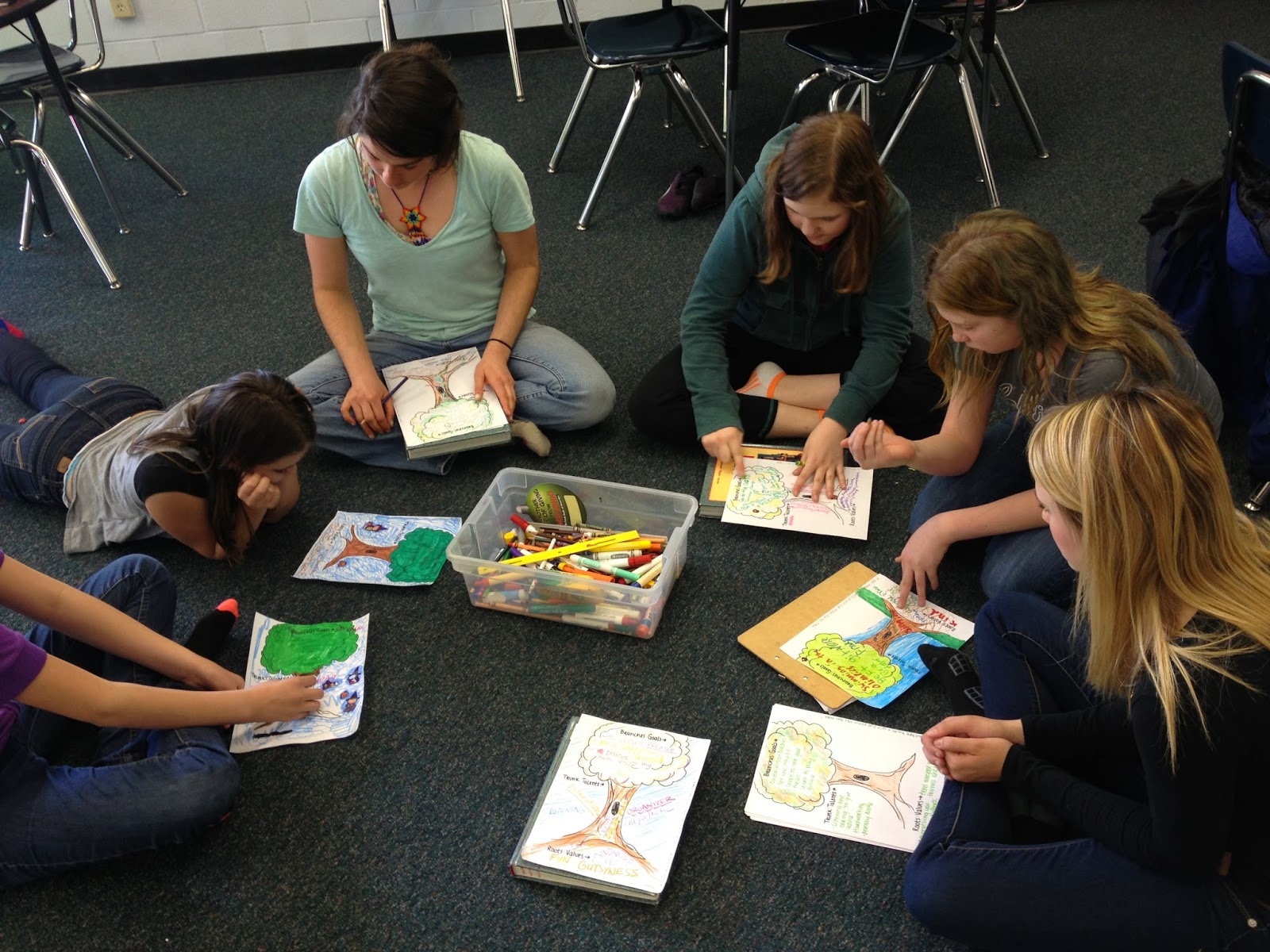
 I was immediately drawn to Molly.  She was quiet, painfully shy, and very hesitant.  It’s not often that people like her stick out in a crowd, especially in a lunch room filled with middle school students.  I noticed her before she even started attending our GUTS! group when I first visited the lunch room at C.S. Porter Middle School to recruit girls for my group. Seeing her sitting alone at lunch struck me.  I approached her individually and invited her to join Girls Using Their Strengths, although I assumed she’d never actually show up.  She didn’t seem like the kind of girl who would jump at the opportunity to be in a group that challenged young girls to try new things and step out of their comfort zones.  But the very next week, to my surprise, she did show up, and I was very glad.  By now I could see on her face that she was longing for relationships with other girls her age, confidence, and a trusted adult to listen to her even if she was unsure of what to expect. 
On the first day of group we made “Me Trees.”  On our trees we used the branches to represent our goals for ourselves.  When it was her turn to share her goals, her cheeks turned bright red, her eyes looked toward the ground, and all she said was, “I want to be better at speaking out loud in front of people.”  After she spoke, I showed her my Me Tree.  On my paper I wrote the very same goal for myself. 
            I am drawn to Molly because I see so much of myself in her when I was in middle school, and I feel like I can understand how she feels and connect with her personality.   She is smart, observant, and deeply caring.  She has so much to say, but she hadn’t found her way of saying it yet. 

Since our first group, I have watched her gain more confidence in herself, build off her strengths, and express her feelings.  She tries new things, she listens, she speaks out loud, and she has made new friends in the process.  I have been inspired by Molly’s bravery and honesty since day one, and she has embodied the true meaning of what it means to be a GUTS! girl.  

Posted by Maddy, Practicum Student with GUTS! 

Monday, October 28, 2013

Crossing the Line

            This blog post was really hard to write. And when I say hard, I mean it’s 3 a.m. and I’m rewriting this for the fourth time because I still can’t get it right. In this post, I wanted to talk about something that’s been bothering me since I started my job as a racial justice intern this summer. When I took this job, I had a fairly strong background in women’s and children’s issues, however racial justice was something I was (am) still learning about.

Since taking on the role of racial justice intern, I’ve noticed patterns in myself and those around me regarding how we externalize our perceptions of race and privilege. For the first time, I’ve begun to think of myself as more than female, and more as a white female, and what that means. I’ve begun to look more closely at who my friends are, and how they influence my experience of race and gender. Looking at these aspects of my life revealed a wall I’d unconsciously built between who I am at work and who I am outside of work.

I draw inspiration from my personal life and put it into writing for my internship, but I don’t really take a whole lot from my internship into my personal life. This is a big problem because it’s a symptom of the very things I’ve been trying to address; internalized racism and sexism.  

No matter how I act at work, there is a certain line I don’t cross outside the office. That line appears when someone makes a joke about how women are hormonal and unnecessarily dramatic. The line appears when one of my friends (who, if I’m being honest, are predominately white) pretends to be “hood.” The line is there when someone enforces a stereotype about a particular race. The line is there when I laugh along with these jokes, and the line is there when I don’t say anything. The line is there. What I find so hard to accept is the fact that I put it there

My friends all know what I do. They know I’m involved in social activism surrounding racial justice and gender equality, but even those who support my work don’t really like it when I bring it to Friday night get-togethers. Commenting on everyday racism and sexism elicits eye rolls and sarcasm or, if I’m lucky, polite interest.

            At work, I write about racism and sexism because I’ve seen them in action and I’m aware enough to know that it’s wrong, but what I write is irrelevant if I can’t follow my own advice and challenge the problem in the company of my own friends.

            We laugh off issues that affect millions of people because we can; the reason we don’t want to see the issues as anything more than a joke is because when we do, we have to make changes to deeply ingrained behaviors. This is hard. It’s a lot easier to keep laughing than to be the person who points out why it’s not funny, and run the risk of alienating yourself.

Usually when I write a blog post, I try to offer a solution, or at least a helpful hint as to how a problem can be avoided in the future, but this time, I don’t. I don’t have a solution because I’m still learning how to translate the work I do, and the things I believe, into something I don’t have to sugarcoat in order to be accepted. It’s hard for me, but living with sexism and racism is harder for all of us. Facing my bias’ will always be a challenge, but as my mother likes to remind me, I am stubborn as a mule so…

… challenge accepted!

By Juliana Rose, YWCA Missoula Racial Justice Intern

Wednesday, October 16, 2013

Uncover Missoula Fails to Recognize the True History of Missoula

According to an article in “Uncover Missoula, “a publication of the Missoulian newspaper the city’s history began in 1860 with a settlement known as Hell Gate. The standard article included in the past two editions failed to recognize important events relating to American Indians and their deep historical connection to Missoula.
According to the Flathead Watershed Sourcebook Archaeologists have found sites in the South Fork of the Flathead River that indicate people have been living in Western Montana as far back as the end of the last ice age (10,000 years ago).  Ancient stories of the Salish and Kootenai people tell of living in this area 40,000 years ago.  To say that Missoula’s history begins in 1860 is misleading. That’s like saying gravity began when the apple fell on Isaac Newton’s head. Newton was simply pointing out that gravity exists, in the same way that C.P. Higgins and Francis Worden pointed out to settlers that Missoula was a great place to live. Indeed, it had been a great place to live for many tribal nations for thousands of years. However, Native people were forcibly removed from this region and relocated to reservation lands throughout the state of Montana.
American Indian tribal communities clearly have had significant and sustained relationships with the area of Montana currently known as Missoula. Historical portrayals to the contrary are not only inaccurate, but they are disrespectful, ethnocentric and potentially hurtful to tribal communities – including the Salish tribe, whose language provided the original word that has been altered into “Missoula.”
According to the Confederated Salish and Kootenai Tribes website Salish-speaking tribes (the Séliš and the Qĺispé) and a Kootenai-speaking band (the Ksanka - Ktunaxa) occupied a huge territory covering Western Montana, parts of Idaho, British Columbia and Wyoming, It was in Missoula where they dug bitterroot (sp̉éłm) and fished for bull trout (aáyčst) in the icy cold water of the Clark Fork River (nmisuletkʷ)[1]. Indeed, the Salish place name for the Missoula area is nłˀaycčstm, which translates literally to “Place of the small bull trout.”
The picture painted in the “Uncover Missoula” article portrays early pioneers in Hell Gate, Fort Owen, and St. Ignatius as the few humans strong enough to live in a harsh and “unknown” land. American Indians had been living in these places long before outsiders came to live in this region.  
After the area began to see more White settlement, especially from missionaries and homesteaders, local tribes faced increasing pressure to change their means of subsistence, their religion and to give up their traditional homelands. Agricultural and industrial development in the 1880s put heavier demand on resources like water and land that had once been plentiful.
When Chief Charlo’s band of the Bitterroot Salish were forced to march to the Flathead Reservation in 1891, the region’s tribes began to see a whole new level of cultural erosion. Indian children were taken by force from their families and placed in boarding schools (for example, the Ursuline Academy in St. Ignatius) where they were forbidden to speak their Native languages or participate in their traditional tribal spiritual practices. 
History is, for the most part, written by the conquerors, and the history of American Indians is often whittled down to the simplified version of settler versus Indian as taught in elementary schools. The chopping of Native history from basic education demotes an entire people’s history to second-class status. When we treat a people’s history as second class — or even worse, deny it all together — we continue to marginalize tribal people and systematically treat them in unequal and possibly discriminating ways. If the news media desires to educate their readership on Missoula’s history accurately, American Indians must be acknowledged, and their history valued.   We hope future issues of “Uncover Missoula” will portray an inclusive history of not only the White settling of Missoula, but also of local tribes and their history in the Missoula area.
This commentary is a product of the racial justice initiative of the YWCA Missoula. Our goal is to promote racial justice in Montana through timely, informed, news-based education. For more information about the racial justice initiative, visit ywcaofmissoula.org. This is Juliana Rose, the Racial Justice Intern with the YWCA.  Thank you for listening. 
By Juliana Rose, YWCA Missoula Racial Justice Intern
This commentary aired on Montana Public Radio on Friday, Oct. 11
(Click here to access the archived podcast of this newscast. Juliana's  
commentary begins at 22:59)

Links Referenced:
“New evidence puts man in North America 50,000 years ago”

Louis Adams and Tony Incashola (two Salish elders) interviews

“Montana Indians, Their History and Location”


[1] Also thought to be the origin of the name Missoula. Root is suuˀ - subsided water. (Pete, T. , 2010, seliš nyoˀnuntn: Medicine for the Salish language.  Lincoln, NB: University of Nebraska Press.)


 [AO1]Find correct pronunciation or read for radio as, “Indeed the Salish place name for the Missoula area translates to ‘Place of the small bull trout.’”

Tuesday, October 1, 2013

Advocate Training-- An Insider's Perspective


“I’ve learned that people will forget what you said, people will forget what you did, but people will never forget how you made them feel.” These words spoken by Maya Angelou, clearly align with the work of an advocate, as advocates help survivors validate their feelings, discover their strengths, learn to choose for themselves, and work towards change.

Entering into the first Saturday morning of advocate training, I slowly became awakened to the role of advocacy and its roots within empowerment. As advocates, we are in the unique position of being a witness to individual stories, to listening with an open heart, and engaging in a process where individual survivors begin to regain their own personal power.

The first training presentation, through the National Coalition Building Institute (NCBI), quickly got a room of thirty trainees to wake-up, clap, cheer, and be recognized for characteristics that define, and give meaning to who they are. I was recognized as an oldest child, someone born in a state other than Montana, and a woman. I was immediately engaged. I laughed, waved, and smiled as if I were on the Ellen DeGeneres Show. It was clear that the presentation was meant to recognize all of the diversity within the room, while simultaneously creating space for unknown traits and experiences that piece together to make our own individual story. It broke down stereotypes while giving us the tools to understand our own biases and perceptions when we approach others. They identified labels we make for ourselves and each other, illustrating how we interact within and outside the caucuses in which we engage. Subsequent presentations built off the NCBI presentation, forming a foundation of invaluable knowledge needed to volunteer and provide services.

Advocacy training lasts more than two weeks, which equals over forty hours spent within the YWCA’s center room. For those forty hours, thirty trainees, including myself, had the chance to interact and listen to numerous stories revolving around the issues of domestic violence and sexual assault. The stories and training delve deeper into the issues, and create a holistic picture of how domestic violence relates to other human rights topics such as homelessness, culture assimilation, and mental health.  Throughout training, we learned about the services provided within Missoula that aim to address these issues. However, more importantly, we learned how to advocate for survivors that come to us with varying experiences and stories.

When training concludes on October 3rd, I am confident that I will have the necessary tools to become an engaged advocate working to empower survivors and their children. 


Posted by Jessica, YWCA Missoula Advocate Trainee

Wednesday, September 18, 2013

VISTAs Collect 862 Toiletry Items for Women and Families

As AmeriCorps VISTAs (Volunteers in Service to America), we are expected to participate in any and all National Service Days to help give back to the community directly - Sept. 11 being one of them. The purpose of 9/11 Day of Service is to honor the victims of the September 11 terrorist attacks in America through a voluntarily observed national day of service, charity, and compassion and encouraging people everywhere to set aside time to help others in need. 


This year, the VISTAs and VISTA leaders organized the 2nd Annual “Great Roll Out” toiletry drive benefiting YWCA Missoula! Sept. 9 -11,VISTAs and members of the Jesuit Volunteer Corps of Missoula set up at four store locations and collected toiletry donations that the YWCA housing programs and Pathways program were in need of. I was so surprised with how generous people in the community were! We not only received more toiletries than we ever expected, but we collected cash donations as well. Maura, the Pathways VISTA at the YWCA is responsible for putting a great amount of work into the project. 


Because of the time and dedication from our AmeriCorps volunteers in Missoula, the "Great Roll Out" 2013 was a huge success: we collected $2,079.74 worth of cash/in-kind donations, including 862 toiletry items, to benefit YWCA programs. Thank you to Orange Street Food Farm, Super Wal-Mart, Patty Creek Market and Albertsons East for participating in our toiletry drive and allowing for this to happen!

Posted by Miranda, YWCA Missoula Transitional Housing VISTA


Thursday, September 5, 2013

New AmeriCorps Volunteers Ready to Fight Poverty in Missoula!

Hey there! My name is Miranda, and I am the new AmeriCorps VISTA (Volunteers in Service to America) in the Transitional Housing Program at YWCA Missoula. I am originally from Napa, Calif., but I moved up to Missoula for my undergraduate studies in Psychology and Communications. I started out volunteering at the front desk about two years ago and couldn’t get enough, so I went through Advocate training and Children's Advocate training to gain more knowledge and skills and give more time to the YWCA. During my senior year of college, I had an internship through the GUTS! program, which helps girls identify and use their strengths. 

After graduating from college, I decided to join the VISTA program and chose the YWCA as my host site to serve for the next year. I am not sure what my plans are for the future - perhaps graduate school, perhaps more non-profit work - but either way, the YWCA is a great experience and opportunity for me on so many different levels.

Traveling is one of my passions, and as I started to travel more often I realized that poverty and suffering is everywhere. I hope to go back to these places and help to end poverty across seas, but it is very important to recognize the issues folks in our local community face every day as well. That is why I am here. My other passion is giving and helping out those in need, whether it be resources, a meal, or even a literal helping hand.

I have a year full of capacity-building and service ahead of me, including being a part of YWCA Missoula's Brown Bag Lunch Series team, conducting focus groups for our program participants, working on Project Homeless Connect, doing presentations about YWCA services at other local organizations, assisting with orientations and interviews, as well as outreaching to the community so that we can improve our services. It has been such a pleasure being part of the YWCA crew already! It is so comforting knowing that I work with a group of strong, smart, considerate and giving women every day and that we are making a difference in countless families’ and community members' lives. 

Miranda (left) and Maura (right) are excited to serve YWCA Missoula this year! 

Greetings! My name is Maura, and I am so sincerely happy to be here at the YWCA as the new AmeriCorps VISTA for the Pathways Children’s Program.  I first came to the YWCA two years ago as a volunteer with the GUTS! program and was immediately impressed by the variety of services and the scope of impact the YWCA has in our community. 

Working with children has been a passion of mine for as long as I can remember, and this passion has resulted in many adventures, such as traveling to China to teach English, as well as discovering AmeriCorps in Spokane, where I taught children skills to help them achieve success in reading as a member of Washington ReadingCorps. 

Each time I leave Montana, I know it is only temporary because Montana is my home and indeed where my heart is. I grew up outside of Bigfork, and I am fortunate to be able to continue to go home and visit my family and pets often. I find peace in the beautiful views of the Swan Mountains and Jewel Basin, as well as the spectacular night sky.

I attended the University of Montana and received a bachelor of arts in Psychology with a Philosophy minor, and I also enjoyed many Sociology and Social Work courses.  I am currently taking online classes to become certified in Non-Profit Administration, and one day I hope to have a position in an organization like the YWCA, working to help children and adults develop the skills and tools that will enable them to reach their goals and make their dreams a reality.


Tuesday, August 27, 2013

Keff-what? Art and Appropriation

On the very first day of one of my high school art classes, my Theory of Aesthetics teacher sat us down and asked us a question: “What is art?” Surely this was a rhetorical question - this was an art class after all, and he, the teacher, was supposed to answer that question for us. But it wasn’t a rhetorical question.

Here’s the thing about art: it needs inspiration. The Greeks knew this better than anybody; they worshipped nine muses dedicated to the preservation of the creative spirit. But where we get our inspiration and how we use it can have a big impact on whether art is art, or say, plagiarism.

We all know that plagiarism is a major no-no because it’s a lie. It’s fine to draw inspiration from artists who’ve already done really cool stuff, but downright copying, especially without giving credit where credit is due is not okay.

But what about cultural plagiarism? Does that even exist? Can you steal someone’s culture? Is it even stealing when you do? I mean, we live in America, the melting pot, isn’t that kind of the point? We take everything and make it better?

Well, no. It is stealing when you take someone’s cultural traditions and symbols and make them your own, in whatever sense that may be. In fact, it’s called “cultural appropriation.”

So why do you have to worry about it? Well, let’s look at one form of art I can guarantee you’ve been exposed to on an everyday basis since you were old enough to know what cool is: fashion. Fashion is everywhere and trends come and go about as quickly as boy-bands.  Somewhere in that drive to hop on to the next big thing in fashion, we’ve forgotten to stop and check whether or not that absolutely adorable Aztec print top is buying into the latest and greatest cultural appropriation trend.

What’s the difference between cultural appropriation and cultural appreciation you ask? Let’s take a look. The clothing and accessories worn by different cultures are important because they symbolize certain elements of their heritage or their religious practices. A pattern and the colors in it could have a very specific meaning for a group of people. For instance, in many regions of Africa and the Middle East textile patterns were and are used to identify tribes, heritage and political loyalties. When those patterns start popping up on shelves in the U.S. there are a couple of issues. The first and foremost is that no one really understands where the pattern comes from or what it could mean, only that it gets you “that look.”  There’s no understanding about who the original creator of that pattern is, or what cultural implications it has beyond how well it matches your new pants.

Photo courtesy http://sunshinejoy.com/page/Keffiyeh_Scarves.html

Ever heard of a Keffiyeh? How about those cute hipster scarves with those cool patterns? Yeah, you know what I’m talking about. BAM. Cultural appropriation. The scarf trend draws its inspiration from the Keffiyeh. The Keffiyeh is worn throughout the Middle East, and it carries a lot of significance in countries like Jordan and Palestine. So that cute hipster look isn’t just a fashion forward way to keep your neck warm; it’s a symbol of patriotism and heritage to people clear on the other side of the globe.

Wearing these trends like it’s nothing is a problem because they come from a place of history. There’s meaning and importance associated with a lot of symbols that we have no clue about. It’s one thing to travel somewhere, learn about a culture and bring back a piece of clothing or an accessory as a memory of that trip. In doing so, you are demonstrating cultural appreciation and you actually have some clue what you’re wearing and why it means something.

Going into American Outfitters and picking up the latest in tribal prints is one of the most blatant forms of disrespect out there. When we buy clothes without understanding what we’re wearing, we’re basically telling a lot of people around the world that their cultures and traditions aren’t important to us; that they’re just part of a trend that we can cast off whenever something better comes along.

It’s not easy to avoid cultural appropriation when you’re out shopping. But you can do it. Helpful hint: those feather headdresses you’re about to drop a couple hundred bucks on are definitely not okay. Take a second and research the history and significance of headdresses to Native Americans and you might find yourself thinking twice about wearing one to your next rave. Understanding where these trends are coming from not only increases your knowledge, but helps you to avoid the pitfalls of spending your money on something that disrespects someone else.

In fact, the more you know, the more you can direct your spending choices toward something that can actually help other people. Take the project 3Strands, which employs victims of sex trafficking and produces bracelets that you can buy in stores like Whole Foods and Apricot Lane. Money from sales helps free women from trafficking and employs women who would otherwise be shunned.

Money speaks pretty gosh darn loudly, and you say a lot with what you buy. Art is beautiful and wonderful. It’s great to push the boundaries with what counts as art and what’s acceptable, but when it comes to your closet, make sure you understand the fashion statements you’re making, or else you could end up saying more about yourself than you realize.


Thursday, August 15, 2013

Planet Kids' Staff Are Keeping New Hampshire In Their Thoughts


While some of us at Planet Kids were working on Sunday morning of Aug. 11, 2013, providing supervised visitation; there was a horrible tragedy happening in a place providing the very same services in Manchester, N.H.

Please keep all of the children and parents that are victims of domestic violence in your thoughts. Help to cure the cycle of violence. Report any form of violence that you suspect and help to promote peace.

The victims in New Hampshire are in our thoughts here at Planet Kids, and we send the utmost love to you.

Posted by Amber, Planet Kids visit monitor.

Tuesday, August 13, 2013

Expanded Secret Seconds Thrift Store to Reopen August 14

The Broadway location of Secret Seconds  is reopening on Wednesday, Aug. 13. The new store looks great, and we are so excited! 


We are now accepting donations, and we even have room for gently used furniture with all of the additional space. 

Take a look at how it's coming along, and come see us on Wednesday. 


And of course, Secret Seconds staff can help you pick out exactly what you need. We are pretty talented. 

Thanks for your support!

Posted by Shelby, Secret Seconds store staff

Friday, August 9, 2013

Paula v. Paul

In legal cases of defamation, there is a certain standard that is applied to people in the public eye. In order for a celebrity to prove that she has been defamed, she must prove that there was something called “actual malice.” This means the celebrity has to prove the person defaming her spread lies on purpose and completely ignored the truth. Now let's look at what happens when a celebrity is the one doing the defaming. Do we hold celebrities to the same standard? Do we look at the intent behind the celebrity’s words and actions and judge him accordingly?

A celebrity perpetuating racism could be accused of spreading lies — after all, isn't racism one big lie after another – A lie to himself and to humanity? By what standard do we judge celebrities when they spread racism? Celebrities need publicity in order to be, well… celebrities. News media sources know this; they also know that if they can get us to pay attention to a story, they can run with it.

We need to start using the actual malice standards when it comes to celebrities behaving in ways that are detrimental to our society. Let’s look at an example of the actual malice standard at work with two public figures who messed up big time with racist behavior.

The celebrity chef, Paula Deen, was once associated with extreme butter usage – now she’s associated with racism and a career that's going up in flames. On top of that, allegations of Deen running a hostile and racist work environment have surfaced. Okay, she screwed up. We all screw up sometimes, but the question is, how did she fix it? Well, she apologized…and she fired her agent. Great! Real change has been made. Now that Deen begged forgiveness, a serious transgression has been righted and the world has learned a valuable lesson: When you screw up, fire your agent.

Earlier this year, celebrity chef Paula Deen dealt with allegations that she was running a hostile and racist work environment. Photo courtesy Digitas Photos. 

Pause. Remember that actual malice standard? Was there intent? Did Paula Deen know that she was spreading lies and ignoring the truth? I think her behavior indicates that she did know what she was doing; she’s just floundering now that she’s been caught in the act of bigotry.

Let’s take a look at someone else who screwed up. More specifically, a company — Paul Frank Industries. You probably know the company by its trademark monkey face logo. For 2012’s "Fashion's Night Out," Paul Frank LA held a Native American Powwow-themed party. The entire event capitalized on stereotypes about Native Americans through the usage of feathers, tomahawks and war paint. The company was called out by blogger Adrienne K, administrator of Native Appropriations.  Much to her surprise, not only did Paul Frank Industries respond to her letter, but also asked for her help to learn and grow from the situation.

Last year, Paul Frank Industries apologized for capitalizing on Native American stereotypes at one of its fashion parties. Photo taken at Paul Frank store in Berlin, courtesy of Brian Caldwell.

The president of Paul Frank Industries responded to Adrienne K directly and requested the blogger's help to change how the company was using Native American imagery. Since then, the company has collaborated with Native designers like Dustin Martin and Autumn Dawn Gomez, in addition to pulling offensive imagery from its stock photos. The company's response to the incident demonstrated contrition and a true willingness to change.

Actual malice standard? I think we can safely say that Paul Frank Industries realized they had unintentionally offended a lot of people and tried to make sincere amends. Paula Deen? Not so much.  

Every turn of the Paula Deen saga has been picked up by major news sources and spread across headlines. Meanwhile, Paul Frank has received limited media attention. Who are we rewarding? Paula Deen. By paying attention to her story and continuing to read and watch stories about her, we are only encouraging news sources to continue their coverage. In looking for news sources that are covering people who actually strive to rectify their mistakes and move beyond their bad behavior, we let the world know what we do and don’t support.

As long as we keep paying attention to people like Paula Deen and ignoring stories like Paul Frank Industries, we will never see the change that is trying to happen. The media has made a very clear declaration of which story it thinks is important for the public to see. As a result, Paula Deen is the story that will influence the people who hear it. It's the story that people will remember when they think of racism. It's the story that will ultimately influence their behavior.

Is Paula Deen's behavior really the standard we want the media to set for us?  

Posted by Juliana Rose, YWCA Racial Justice Intern