Tuesday, May 27, 2014

YWTalks: A Community Social Justice Series Wrap-Up

Well folks, the YW Talks: Community Social Justice Series has coming to an end. It has been a wonderful season this year with a combination of men and women speakers addressing social justice issues that are pertinent to women and those of diverse ethnic backgrounds. We also changed the name of our series from the “YWCA Brown Bag Lectures Series” to the new “YW Talks.” Why did we change the name you ask? Turns out the term “Brown Bag” has a negative association attached to it and here is why:

A “test”, which had the common use in the early 1900s among upper class Black Americans and families, was used to determine if a Black person was “white” enough to gain admittance or acceptance. If your skin was darker than a brown paper bag, you were not valued or included. Thousands of Black institutions and schools including the nation's most well-known Black fraternity, Phi Alpha Phi at Howard University, practiced this discrimination. As an organization that has a racial justice initiative incorporated in its mission, we were not interested in supporting this term any longer by using it in the title of our community lecture series.


I have really enjoyed being the coordinator for YW Talks: Community Social Justice Lecture Series this year. It has been a pleasure engaging with Missoulians who present on such important topics and create a space for dialogue and discussion for our community members. I hope that this series continues to grow and expand as a predominant piece in creating social justice in our community and even on the larger scale.

Our presenters for this season included:

September: Anisa Goforth: Arab American Students

October: Helga Hosford: Personal experience in Nazi Germany

November: Tobin Shearer: Iceberg Theory to Racism

December: Phyllis Ngai: Intercultural Communication and Social Justice

January- Anya Jabour: Women’s History and Racial Justice

February-Ruth Vanita: Hindu Goddesses

March-Mehrdad Kia: Islam and the West

April-Amber Gladney: Peace Corps experience in Africa

May-Suzette Dessault: Women’s Suffrage in Montana


Posted by Miranda, Transitional Housing VISTA

Monday, April 14, 2014

Fight For Hope and Freedom: Human Trafficking, Montana & the World


EVENT ANNOUNCEMENT: University of Montana Mansfield Center Conference on Human Trafficking: “Fight for Hope & Freedom – Human Trafficking, Montana and the World”
April 16th and 17th  at the University Center – FREE ADMISSION

Human Trafficking is modern day slavery exploiting an estimated 30 million people worldwide. More people are living in slavery now than at any other given point in history! Human Trafficking is a high-profit, low-risk crime and the fastest growing industry in the world after the drug trade. Trafficking is no longer a crime that happens only in the brothels of Thailand and other South-East Asian countries. In fact, it has become one of the most serious human rights and social justice issues of our time, impacting foreign nationals and U.S. citizens alike. However, many people believe that labor and sex trafficking doesn't happen in North America and especially not in Montana – we only see what our eyes are trained to see, right? – and consequently, misinformation and missing information governs our laws, funding options, and services available to survivors. We call it “prostitution” and like to think that women voluntarily engage in sex for money; since prostitution is illegal, the girls and women are often arrested, while the “Johns” get a slap on the wrist, turn around, and find the next vulnerable woman on the internet.

We are seeing a rapidly increasing number of survivors of sex and labor trafficking in the United States, including the Big Sky country of Montana. In 2012, the Polaris Project, the leading Anti-Trafficking NGO in the US, reported a total of 20,652 calls on their crisis line – 34 of those calls came from Montana. Minor girls are being advertised on online sites like Backpage.com. We see examples like the “boyfriend- turned-pimp” who forces a runaway teen to engage in sexual acts in exchange for a roof over her head, food, and the “true love she has never known.” Cases like this point to another sad fact: the majority of both children and adult women that end up in the sex industry, were victims of child sexual abuse prior to “recruitment.” We are talking about an industry that targets people that have been victims of trauma; an industry that preys on the most vulnerable and marginalized people in our society.

As a society, a community, and as fellow humans, we have a responsibility to address this social injustice  and ensure safety, support, proper resources and overall justice for the many women & girls, men & boys across the U.S. and worldwide who are being forced into slavery. This also means that we have to strive to be proactive and address the root causes and larger systemic issues behind the problem – gender-based violence, equal opportunities for all young people, the impact of racism in our society and much more. The first step of this process is raising awareness through education so we all have the tools to identify and respond when we see potential red flags of trafficking in our communities. This year’s Mansfield Center Conference promises to deliver just that, by convening  leading international and national experts in Missoula to address this challenging topic. I hope to see many of you there so we can move forward and fight to end human trafficking together!


Full agenda and registration info here: http://www.umt.edu/mansfield/events/conference/

Posted by Kat Werner, YWCA Pathways Program Manager

Friday, March 28, 2014

Reflections On Race and Reading

             When I was a kid I loved to read so much that my mom would ground me from reading the way other parents would ground their kids from TV. I had to have a book EVERYWHERE I went, even the supermarket. This reading addiction, while not always beneficial to social interaction, was beneficial for my future as a “thinker and a doer” in society. Of all the skills I learned from reading, the ability to empathize with a character and truly put myself in their shoes was the most important.
            Recently while reflecting on these early childhood experiences with books, a thought popped into my head. Would a little girl of a different color than me have had the same experience? Would a little girl, like me in every way but color, have had the same plethora of stories to identify with and dive into?  Growing up I read a lot of books about girls in different cultures and of different races, but how might my experience have been different if I had been born outside the dominant culture?
            With this thought in mind, I decided to take a field trip to the Missoula Public Library. After accruing my usual too-tall stack of books, I headed to the children’s section. I began pulling books off the shelves at random and looked at the illustrations. I only spent about half an hour reading (I was getting the stink eye from a little boy eyeing my spot on the couch), but it was enough time for me to notice something. The number of books with a person of color in them was pretty darn low. The books with animals as characters had more diversity than most of the books with people in them.
            That’s not to say there weren't some stories about, and including people of color, but the point is that there weren't as many as there should be to accurately reflect the reality of the world (fictional or not). This isn't an intentional omission on the part of the library, it’s a symptom of a greater system at work, Portions of our population are being left out of the literature we are using to inspire our children and young adults (this coming from a youngish adult herself).
            The more I thought about it, the more I realized that most of the books I pick up in the young adult section of the library don’t have a whole lot of characters of color. If you take a second to think of some of the most popular young adult novels out there, you might notice that most of them center on white heroes and heroines. For example on NPR’s list of the 100 best-ever teen novels, of the top five books listed, none have a main protagonist who isn't white. To Kill A Mockingbird is the only book in the top five that directly deals with race.
Under representation of minorities is in no way new or surprising, but my little field trip to the library got me thinking. What’s causing this under representation in the literary world? Is it the lack of writers of color? Is it a lack of white authors being interested in, or accurately writing stories about people of color? Is it a lack of an audience? Are writers of color not being encouraged? What’s the deal? Male writers write about females. Female writers write about men. White people obviously have no problem writing in supporting characters of color, so why is there an absence of main characters who are different colors? Personally, I think that when the majority of writers sit down to write, they either write what they know, or they write what they wish they knew, and somewhere in there, racial diversity in characters is getting left out.
            Reading is supposed to be an immersive experience. It is an activity which is solely dedicated to understanding the thoughts and feelings of other people, their motivations and their desires, what makes them who they are as a human being. Books can have huge ramifications in society; they are a pulse point of modern society’s concerns and cares.
            In order for our society to grow we have to expand the diversity of our literature. I don’t mean that we need more niche books specifically about race. I mean that we should have more books that reflect the complexity and diversity of our society. As long as people of color remain underrepresented in the literary world, our children and young people are facing yet another arena in which racial diversity looks like a token book here and there, not the status quo.
            At this point, as in many of my blogs, I am left with a question. What can I personally do? I think the first step is to highlight the literature that’s already out there that is inclusive. So here’s where I ask for your help. What recommendations do you have for reading? What books do you read to your kids that encourage racially sensitive thinking? Let’s compile a starter reading list, so that we’re all a little better informed about the books which not only entertain us, but make us more socially conscious people as well. 

----
Related Information:
YWCA Missoula is excited to announce that the University of Montana will be holding a conference on race and creative writing on April 10. 

"The goal of the conference is to address the relative paucity of discussions on the topic of race and creative writing in the academy in general. The panels and readings will bring to the discipline and teaching of creative writing perspectives from critical race theory, poetics, performance studies, literary theory, ethnic literature, and Native American and Indigenous studies."

For more information about the conference click here.

Posted by Juliana Rose, YWCA Missoula Racial Justice Intern

Tuesday, March 11, 2014

Pet Advocates Ease Transition for Domestic Violence Survivors

Samantha and Roxy had been the best of friends since Roxy was little.  Everywhere Samantha went, Roxy went.  Everything Samantha did, Roxy did.  Samantha would confide in Roxy, cuddle with Roxy, and enjoy comfort and support from Roxy.  Roxy was Samantha’s 70lb black lab whom she had raised since she was a puppy.  Roxy was 6 years old when Samantha moved in with her boyfriend, Rick.  It didn’t take long for the abuse to start and often it was directed toward Roxy.  When Samantha was ready to leave the relationship, she called the crisis line to inquire about emergency shelter.  She was informed that she could not have Roxy at the shelter.  Samantha hung up the phone and cried.  She was now faced with the decision to leave Roxy behind, risking more harm or even death to Roxy, or to stay in the relationship to be with Roxy and protect her from the abuse.

Imagine being faced with this decision.  Imagine having to leave your best friend behind.  Roxy had been Samantha’s comfort and support her entire life and especially during the abusive relationship.  Unfortunately, pets are often used as pawns in abusive relationships.  Abusing the survivor’s pet is another way for the abuser to manipulate or threaten the survivor and gain power and control.  Survivors often delay leaving an abusive relationship if they cannot take their pet with them, or find a safe place to keep their pet.

This is why the YWCA created the Pet Advocate program.  The Pet Advocate program provides foster homes for pets of survivors staying at our domestic violence shelter.  By providing these foster homes, we can remove one more barrier for people looking to leave an abusive relationship and offer the survivor peace of mind, knowing that their pet is safe.  Pets offer a special type of love and comfort to their owners, and it is our goal to help survivors keep their pets.

Pet Advocates are volunteers who have gone through training to learn about the complex relationship of pets and domestic violence,  and the unique characteristics of caring for pets who may have been abused.  These amazing volunteers open their homes and hearts up to these pets and love them as if they were their own.  The YWCA partners with the Humane Society of Western Montana, who provides food, vaccinations, and their expertise on animal behavior.


The YWCA is always in need of more volunteers to become Pet Advocates.  The only requirement to become a Pet Advocate is the ability to foster pets and offer love.  Our next Pet Advocate training will take place on Thursday, March 20, 2014, 6:00PM – 8:00PM.  If you are interested in attending the training, or learning more about the Pet Advocate program, please contact the Pet Advocate Coordinator, Lisa J. Bruce, at (406) 543-6691 or lbruce@ywcaofmissoula.org.

Posted by Lisa Bruce, Gateway Program Manager

Monday, December 2, 2013

A Tribe Called Red

              Last night, while I was hanging out with some friends, one of them asked me if I had ever heard the electronic dance music (EDM) group called “A Tribe Called Red.”
            “A tribe called what?” I asked.  My friend shook his head and put on this song. The first thing that ran through my mind was, “I’m in love.” My second thought was, “Should I even listen to this?” I really hoped I wasn’t listening to cultural appropriation in the most blatant, bass-pumping, chill-giving form imaginable.
            So today, I did a little homework and found out some very exciting things. Not only is 100% acceptable for a culturally sensitive person to listen to A Tribe Called Red, the group deserves a big shout out for everything they’re doing. 
            The group is comprised of deejays Shub, Bear Witness and NDN. All the members are First Nation indigenous people from Canada. They remix traditional powwow music with electronic music to produce a sound that is unique to say the least. Through their music exploration, they’ve created a new niche in the ever-changing EDM scene called “electric powwow.”      
            Not only do they make great music, they give voice to issues affecting native populations.  Their song “Woodcarver” is about the 2010 shooting of John T. Williams, a totem wood carver in Seattle, Wash. The song combines audio of the shooting itself and news reports of the incident.
            They have addressed their fans directly when it comes to issues of cultural appropriation. They weighed in on the issues of racist sports team names and white fans wearing headdresses. Beyond social commentary, they’ve rallied together native communities across Canada and the U.S. “The way that the aboriginal community has owned our music is amazing,” DJ Bear Witness said in an interview with Noisography.com. “A Tribe Called Red is more than what we do, it’s the movement that started around what we do and the way people in our community have said this is what we need, we identify with it, this is for us.”
            I might be jumping on the bandwagon a little late, but I’m glad I’m on it. Listening to music from an amazing group can only be improved knowing that they’re working to increase awareness about issues that often go unnoticed by “the mainstream.” 
            If you’re interested in hearing more from this band, download their debut album for free here, and check out their Facebook page.  
            Happy Listening!


Posted by Juliana Rose, YWCA Missoula Racial Justice Intern

Tuesday, November 19, 2013

Finding Your Voice


 I was immediately drawn to Molly.  She was quiet, painfully shy, and very hesitant.  It’s not often that people like her stick out in a crowd, especially in a lunch room filled with middle school students.  I noticed her before she even started attending our GUTS! group when I first visited the lunch room at C.S. Porter Middle School to recruit girls for my group. Seeing her sitting alone at lunch struck me.  I approached her individually and invited her to join Girls Using Their Strengths, although I assumed she’d never actually show up.  She didn’t seem like the kind of girl who would jump at the opportunity to be in a group that challenged young girls to try new things and step out of their comfort zones.  But the very next week, to my surprise, she did show up, and I was very glad.  By now I could see on her face that she was longing for relationships with other girls her age, confidence, and a trusted adult to listen to her even if she was unsure of what to expect. 
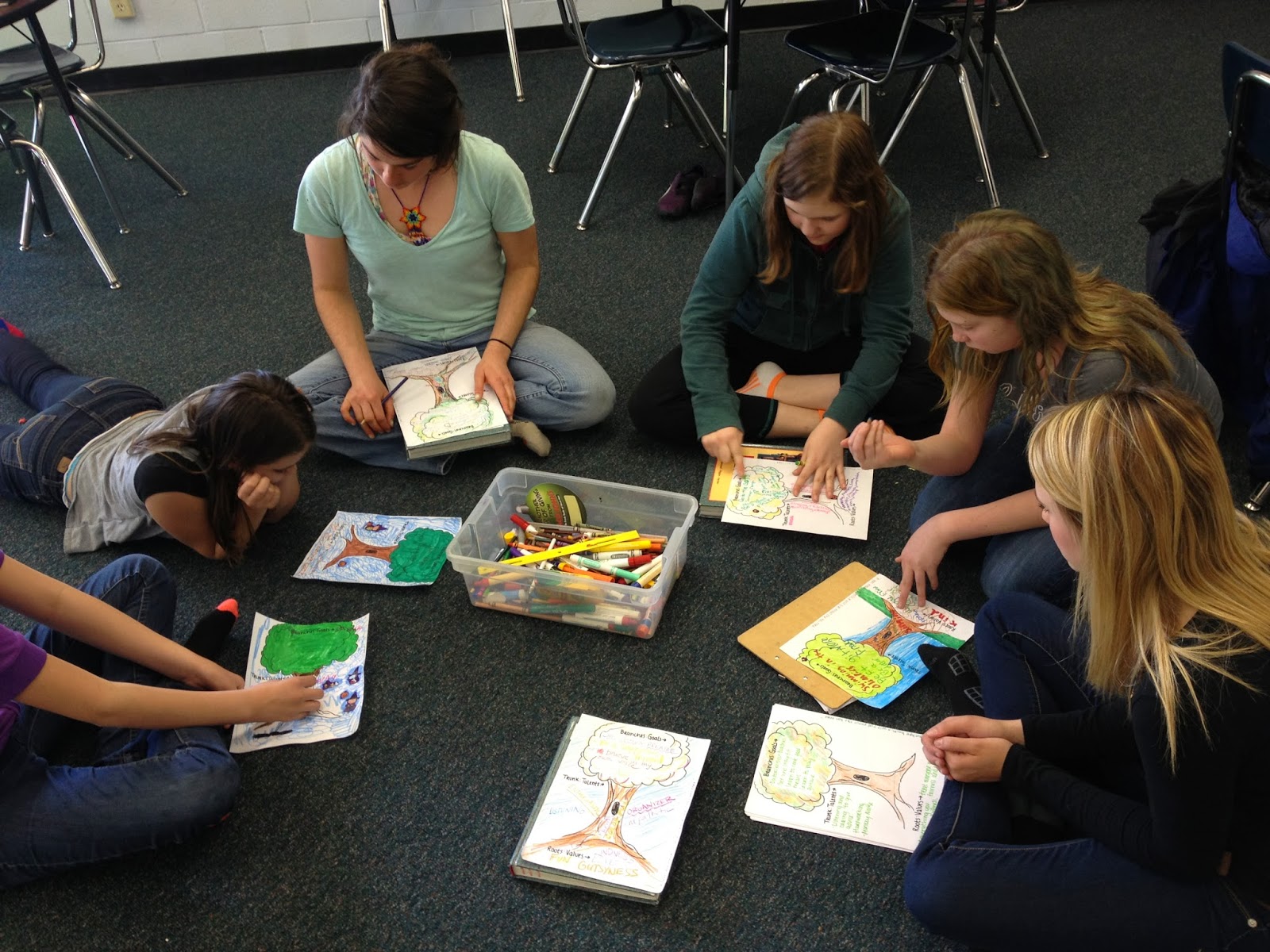
On the first day of group we made “Me Trees.”  On our trees we used the branches to represent our goals for ourselves.  When it was her turn to share her goals, her cheeks turned bright red, her eyes looked toward the ground, and all she said was, “I want to be better at speaking out loud in front of people.”  After she spoke, I showed her my Me Tree.  On my paper I wrote the very same goal for myself. 
            I am drawn to Molly because I see so much of myself in her when I was in middle school, and I feel like I can understand how she feels and connect with her personality.   She is smart, observant, and deeply caring.  She has so much to say, but she hadn’t found her way of saying it yet. 

Since our first group, I have watched her gain more confidence in herself, build off her strengths, and express her feelings.  She tries new things, she listens, she speaks out loud, and she has made new friends in the process.  I have been inspired by Molly’s bravery and honesty since day one, and she has embodied the true meaning of what it means to be a GUTS! girl.  

Posted by Maddy, Practicum Student with GUTS! 

Monday, October 28, 2013

Crossing the Line

            This blog post was really hard to write. And when I say hard, I mean it’s 3 a.m. and I’m rewriting this for the fourth time because I still can’t get it right. In this post, I wanted to talk about something that’s been bothering me since I started my job as a racial justice intern this summer. When I took this job, I had a fairly strong background in women’s and children’s issues, however racial justice was something I was (am) still learning about.

Since taking on the role of racial justice intern, I’ve noticed patterns in myself and those around me regarding how we externalize our perceptions of race and privilege. For the first time, I’ve begun to think of myself as more than female, and more as a white female, and what that means. I’ve begun to look more closely at who my friends are, and how they influence my experience of race and gender. Looking at these aspects of my life revealed a wall I’d unconsciously built between who I am at work and who I am outside of work.

I draw inspiration from my personal life and put it into writing for my internship, but I don’t really take a whole lot from my internship into my personal life. This is a big problem because it’s a symptom of the very things I’ve been trying to address; internalized racism and sexism.  

No matter how I act at work, there is a certain line I don’t cross outside the office. That line appears when someone makes a joke about how women are hormonal and unnecessarily dramatic. The line appears when one of my friends (who, if I’m being honest, are predominately white) pretends to be “hood.” The line is there when someone enforces a stereotype about a particular race. The line is there when I laugh along with these jokes, and the line is there when I don’t say anything. The line is there. What I find so hard to accept is the fact that I put it there

My friends all know what I do. They know I’m involved in social activism surrounding racial justice and gender equality, but even those who support my work don’t really like it when I bring it to Friday night get-togethers. Commenting on everyday racism and sexism elicits eye rolls and sarcasm or, if I’m lucky, polite interest.

            At work, I write about racism and sexism because I’ve seen them in action and I’m aware enough to know that it’s wrong, but what I write is irrelevant if I can’t follow my own advice and challenge the problem in the company of my own friends.

            We laugh off issues that affect millions of people because we can; the reason we don’t want to see the issues as anything more than a joke is because when we do, we have to make changes to deeply ingrained behaviors. This is hard. It’s a lot easier to keep laughing than to be the person who points out why it’s not funny, and run the risk of alienating yourself.

Usually when I write a blog post, I try to offer a solution, or at least a helpful hint as to how a problem can be avoided in the future, but this time, I don’t. I don’t have a solution because I’m still learning how to translate the work I do, and the things I believe, into something I don’t have to sugarcoat in order to be accepted. It’s hard for me, but living with sexism and racism is harder for all of us. Facing my bias’ will always be a challenge, but as my mother likes to remind me, I am stubborn as a mule so…

… challenge accepted!

By Juliana Rose, YWCA Missoula Racial Justice Intern