Friday, March 28, 2014

Reflections On Race and Reading

             When I was a kid I loved to read so much that my mom would ground me from reading the way other parents would ground their kids from TV. I had to have a book EVERYWHERE I went, even the supermarket. This reading addiction, while not always beneficial to social interaction, was beneficial for my future as a “thinker and a doer” in society. Of all the skills I learned from reading, the ability to empathize with a character and truly put myself in their shoes was the most important.
            Recently while reflecting on these early childhood experiences with books, a thought popped into my head. Would a little girl of a different color than me have had the same experience? Would a little girl, like me in every way but color, have had the same plethora of stories to identify with and dive into?  Growing up I read a lot of books about girls in different cultures and of different races, but how might my experience have been different if I had been born outside the dominant culture?
            With this thought in mind, I decided to take a field trip to the Missoula Public Library. After accruing my usual too-tall stack of books, I headed to the children’s section. I began pulling books off the shelves at random and looked at the illustrations. I only spent about half an hour reading (I was getting the stink eye from a little boy eyeing my spot on the couch), but it was enough time for me to notice something. The number of books with a person of color in them was pretty darn low. The books with animals as characters had more diversity than most of the books with people in them.
            That’s not to say there weren't some stories about, and including people of color, but the point is that there weren't as many as there should be to accurately reflect the reality of the world (fictional or not). This isn't an intentional omission on the part of the library, it’s a symptom of a greater system at work, Portions of our population are being left out of the literature we are using to inspire our children and young adults (this coming from a youngish adult herself).
            The more I thought about it, the more I realized that most of the books I pick up in the young adult section of the library don’t have a whole lot of characters of color. If you take a second to think of some of the most popular young adult novels out there, you might notice that most of them center on white heroes and heroines. For example on NPR’s list of the 100 best-ever teen novels, of the top five books listed, none have a main protagonist who isn't white. To Kill A Mockingbird is the only book in the top five that directly deals with race.
Under representation of minorities is in no way new or surprising, but my little field trip to the library got me thinking. What’s causing this under representation in the literary world? Is it the lack of writers of color? Is it a lack of white authors being interested in, or accurately writing stories about people of color? Is it a lack of an audience? Are writers of color not being encouraged? What’s the deal? Male writers write about females. Female writers write about men. White people obviously have no problem writing in supporting characters of color, so why is there an absence of main characters who are different colors? Personally, I think that when the majority of writers sit down to write, they either write what they know, or they write what they wish they knew, and somewhere in there, racial diversity in characters is getting left out.
            Reading is supposed to be an immersive experience. It is an activity which is solely dedicated to understanding the thoughts and feelings of other people, their motivations and their desires, what makes them who they are as a human being. Books can have huge ramifications in society; they are a pulse point of modern society’s concerns and cares.
            In order for our society to grow we have to expand the diversity of our literature. I don’t mean that we need more niche books specifically about race. I mean that we should have more books that reflect the complexity and diversity of our society. As long as people of color remain underrepresented in the literary world, our children and young people are facing yet another arena in which racial diversity looks like a token book here and there, not the status quo.
            At this point, as in many of my blogs, I am left with a question. What can I personally do? I think the first step is to highlight the literature that’s already out there that is inclusive. So here’s where I ask for your help. What recommendations do you have for reading? What books do you read to your kids that encourage racially sensitive thinking? Let’s compile a starter reading list, so that we’re all a little better informed about the books which not only entertain us, but make us more socially conscious people as well. 

----
Related Information:
YWCA Missoula is excited to announce that the University of Montana will be holding a conference on race and creative writing on April 10. 

"The goal of the conference is to address the relative paucity of discussions on the topic of race and creative writing in the academy in general. The panels and readings will bring to the discipline and teaching of creative writing perspectives from critical race theory, poetics, performance studies, literary theory, ethnic literature, and Native American and Indigenous studies."

For more information about the conference click here.

Posted by Juliana Rose, YWCA Missoula Racial Justice Intern

Tuesday, March 11, 2014

Pet Advocates Ease Transition for Domestic Violence Survivors

Samantha and Roxy had been the best of friends since Roxy was little.  Everywhere Samantha went, Roxy went.  Everything Samantha did, Roxy did.  Samantha would confide in Roxy, cuddle with Roxy, and enjoy comfort and support from Roxy.  Roxy was Samantha’s 70lb black lab whom she had raised since she was a puppy.  Roxy was 6 years old when Samantha moved in with her boyfriend, Rick.  It didn’t take long for the abuse to start and often it was directed toward Roxy.  When Samantha was ready to leave the relationship, she called the crisis line to inquire about emergency shelter.  She was informed that she could not have Roxy at the shelter.  Samantha hung up the phone and cried.  She was now faced with the decision to leave Roxy behind, risking more harm or even death to Roxy, or to stay in the relationship to be with Roxy and protect her from the abuse.

Imagine being faced with this decision.  Imagine having to leave your best friend behind.  Roxy had been Samantha’s comfort and support her entire life and especially during the abusive relationship.  Unfortunately, pets are often used as pawns in abusive relationships.  Abusing the survivor’s pet is another way for the abuser to manipulate or threaten the survivor and gain power and control.  Survivors often delay leaving an abusive relationship if they cannot take their pet with them, or find a safe place to keep their pet.

This is why the YWCA created the Pet Advocate program.  The Pet Advocate program provides foster homes for pets of survivors staying at our domestic violence shelter.  By providing these foster homes, we can remove one more barrier for people looking to leave an abusive relationship and offer the survivor peace of mind, knowing that their pet is safe.  Pets offer a special type of love and comfort to their owners, and it is our goal to help survivors keep their pets.

Pet Advocates are volunteers who have gone through training to learn about the complex relationship of pets and domestic violence,  and the unique characteristics of caring for pets who may have been abused.  These amazing volunteers open their homes and hearts up to these pets and love them as if they were their own.  The YWCA partners with the Humane Society of Western Montana, who provides food, vaccinations, and their expertise on animal behavior.


The YWCA is always in need of more volunteers to become Pet Advocates.  The only requirement to become a Pet Advocate is the ability to foster pets and offer love.  Our next Pet Advocate training will take place on Thursday, March 20, 2014, 6:00PM – 8:00PM.  If you are interested in attending the training, or learning more about the Pet Advocate program, please contact the Pet Advocate Coordinator, Lisa J. Bruce, at (406) 543-6691 or lbruce@ywcaofmissoula.org.

Posted by Lisa Bruce, Gateway Program Manager

Monday, December 2, 2013

A Tribe Called Red

              Last night, while I was hanging out with some friends, one of them asked me if I had ever heard the electronic dance music (EDM) group called “A Tribe Called Red.”
            “A tribe called what?” I asked.  My friend shook his head and put on this song. The first thing that ran through my mind was, “I’m in love.” My second thought was, “Should I even listen to this?” I really hoped I wasn’t listening to cultural appropriation in the most blatant, bass-pumping, chill-giving form imaginable.
            So today, I did a little homework and found out some very exciting things. Not only is 100% acceptable for a culturally sensitive person to listen to A Tribe Called Red, the group deserves a big shout out for everything they’re doing. 
            The group is comprised of deejays Shub, Bear Witness and NDN. All the members are First Nation indigenous people from Canada. They remix traditional powwow music with electronic music to produce a sound that is unique to say the least. Through their music exploration, they’ve created a new niche in the ever-changing EDM scene called “electric powwow.”      
            Not only do they make great music, they give voice to issues affecting native populations.  Their song “Woodcarver” is about the 2010 shooting of John T. Williams, a totem wood carver in Seattle, Wash. The song combines audio of the shooting itself and news reports of the incident.
            They have addressed their fans directly when it comes to issues of cultural appropriation. They weighed in on the issues of racist sports team names and white fans wearing headdresses. Beyond social commentary, they’ve rallied together native communities across Canada and the U.S. “The way that the aboriginal community has owned our music is amazing,” DJ Bear Witness said in an interview with Noisography.com. “A Tribe Called Red is more than what we do, it’s the movement that started around what we do and the way people in our community have said this is what we need, we identify with it, this is for us.”
            I might be jumping on the bandwagon a little late, but I’m glad I’m on it. Listening to music from an amazing group can only be improved knowing that they’re working to increase awareness about issues that often go unnoticed by “the mainstream.” 
            If you’re interested in hearing more from this band, download their debut album for free here, and check out their Facebook page.  
            Happy Listening!


Posted by Juliana Rose, YWCA Missoula Racial Justice Intern
Tuesday, November 19, 2013

Finding Your Voice


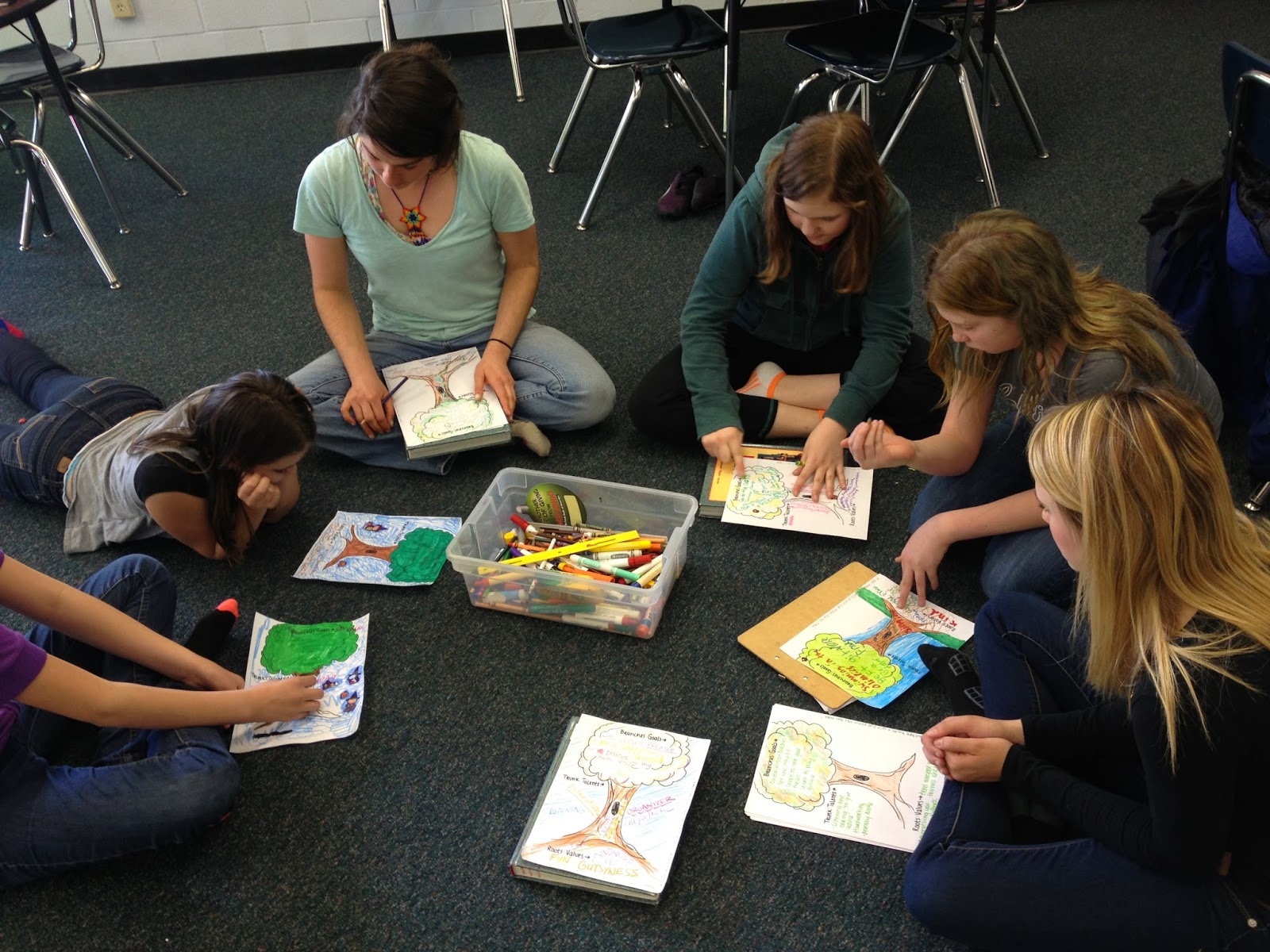
 I was immediately drawn to Molly.  She was quiet, painfully shy, and very hesitant.  It’s not often that people like her stick out in a crowd, especially in a lunch room filled with middle school students.  I noticed her before she even started attending our GUTS! group when I first visited the lunch room at C.S. Porter Middle School to recruit girls for my group. Seeing her sitting alone at lunch struck me.  I approached her individually and invited her to join Girls Using Their Strengths, although I assumed she’d never actually show up.  She didn’t seem like the kind of girl who would jump at the opportunity to be in a group that challenged young girls to try new things and step out of their comfort zones.  But the very next week, to my surprise, she did show up, and I was very glad.  By now I could see on her face that she was longing for relationships with other girls her age, confidence, and a trusted adult to listen to her even if she was unsure of what to expect. 
On the first day of group we made “Me Trees.”  On our trees we used the branches to represent our goals for ourselves.  When it was her turn to share her goals, her cheeks turned bright red, her eyes looked toward the ground, and all she said was, “I want to be better at speaking out loud in front of people.”  After she spoke, I showed her my Me Tree.  On my paper I wrote the very same goal for myself. 
            I am drawn to Molly because I see so much of myself in her when I was in middle school, and I feel like I can understand how she feels and connect with her personality.   She is smart, observant, and deeply caring.  She has so much to say, but she hadn’t found her way of saying it yet. 

Since our first group, I have watched her gain more confidence in herself, build off her strengths, and express her feelings.  She tries new things, she listens, she speaks out loud, and she has made new friends in the process.  I have been inspired by Molly’s bravery and honesty since day one, and she has embodied the true meaning of what it means to be a GUTS! girl.  

Posted by Maddy, Practicum Student with GUTS! 

Monday, October 28, 2013

Crossing the Line

            This blog post was really hard to write. And when I say hard, I mean it’s 3 a.m. and I’m rewriting this for the fourth time because I still can’t get it right. In this post, I wanted to talk about something that’s been bothering me since I started my job as a racial justice intern this summer. When I took this job, I had a fairly strong background in women’s and children’s issues, however racial justice was something I was (am) still learning about.

Since taking on the role of racial justice intern, I’ve noticed patterns in myself and those around me regarding how we externalize our perceptions of race and privilege. For the first time, I’ve begun to think of myself as more than female, and more as a white female, and what that means. I’ve begun to look more closely at who my friends are, and how they influence my experience of race and gender. Looking at these aspects of my life revealed a wall I’d unconsciously built between who I am at work and who I am outside of work.

I draw inspiration from my personal life and put it into writing for my internship, but I don’t really take a whole lot from my internship into my personal life. This is a big problem because it’s a symptom of the very things I’ve been trying to address; internalized racism and sexism.  

No matter how I act at work, there is a certain line I don’t cross outside the office. That line appears when someone makes a joke about how women are hormonal and unnecessarily dramatic. The line appears when one of my friends (who, if I’m being honest, are predominately white) pretends to be “hood.” The line is there when someone enforces a stereotype about a particular race. The line is there when I laugh along with these jokes, and the line is there when I don’t say anything. The line is there. What I find so hard to accept is the fact that I put it there

My friends all know what I do. They know I’m involved in social activism surrounding racial justice and gender equality, but even those who support my work don’t really like it when I bring it to Friday night get-togethers. Commenting on everyday racism and sexism elicits eye rolls and sarcasm or, if I’m lucky, polite interest.

            At work, I write about racism and sexism because I’ve seen them in action and I’m aware enough to know that it’s wrong, but what I write is irrelevant if I can’t follow my own advice and challenge the problem in the company of my own friends.

            We laugh off issues that affect millions of people because we can; the reason we don’t want to see the issues as anything more than a joke is because when we do, we have to make changes to deeply ingrained behaviors. This is hard. It’s a lot easier to keep laughing than to be the person who points out why it’s not funny, and run the risk of alienating yourself.

Usually when I write a blog post, I try to offer a solution, or at least a helpful hint as to how a problem can be avoided in the future, but this time, I don’t. I don’t have a solution because I’m still learning how to translate the work I do, and the things I believe, into something I don’t have to sugarcoat in order to be accepted. It’s hard for me, but living with sexism and racism is harder for all of us. Facing my bias’ will always be a challenge, but as my mother likes to remind me, I am stubborn as a mule so…

… challenge accepted!

By Juliana Rose, YWCA Missoula Racial Justice Intern

Wednesday, October 16, 2013

Uncover Missoula Fails to Recognize the True History of Missoula

According to an article in “Uncover Missoula, “a publication of the Missoulian newspaper the city’s history began in 1860 with a settlement known as Hell Gate. The standard article included in the past two editions failed to recognize important events relating to American Indians and their deep historical connection to Missoula.
According to the Flathead Watershed Sourcebook Archaeologists have found sites in the South Fork of the Flathead River that indicate people have been living in Western Montana as far back as the end of the last ice age (10,000 years ago).  Ancient stories of the Salish and Kootenai people tell of living in this area 40,000 years ago.  To say that Missoula’s history begins in 1860 is misleading. That’s like saying gravity began when the apple fell on Isaac Newton’s head. Newton was simply pointing out that gravity exists, in the same way that C.P. Higgins and Francis Worden pointed out to settlers that Missoula was a great place to live. Indeed, it had been a great place to live for many tribal nations for thousands of years. However, Native people were forcibly removed from this region and relocated to reservation lands throughout the state of Montana.
American Indian tribal communities clearly have had significant and sustained relationships with the area of Montana currently known as Missoula. Historical portrayals to the contrary are not only inaccurate, but they are disrespectful, ethnocentric and potentially hurtful to tribal communities – including the Salish tribe, whose language provided the original word that has been altered into “Missoula.”
According to the Confederated Salish and Kootenai Tribes website Salish-speaking tribes (the Séliš and the Qĺispé) and a Kootenai-speaking band (the Ksanka - Ktunaxa) occupied a huge territory covering Western Montana, parts of Idaho, British Columbia and Wyoming, It was in Missoula where they dug bitterroot (sp̉éłm) and fished for bull trout (aáyčst) in the icy cold water of the Clark Fork River (nmisuletkʷ)[1]. Indeed, the Salish place name for the Missoula area is nłˀaycčstm, which translates literally to “Place of the small bull trout.”
The picture painted in the “Uncover Missoula” article portrays early pioneers in Hell Gate, Fort Owen, and St. Ignatius as the few humans strong enough to live in a harsh and “unknown” land. American Indians had been living in these places long before outsiders came to live in this region.  
After the area began to see more White settlement, especially from missionaries and homesteaders, local tribes faced increasing pressure to change their means of subsistence, their religion and to give up their traditional homelands. Agricultural and industrial development in the 1880s put heavier demand on resources like water and land that had once been plentiful.
When Chief Charlo’s band of the Bitterroot Salish were forced to march to the Flathead Reservation in 1891, the region’s tribes began to see a whole new level of cultural erosion. Indian children were taken by force from their families and placed in boarding schools (for example, the Ursuline Academy in St. Ignatius) where they were forbidden to speak their Native languages or participate in their traditional tribal spiritual practices. 
History is, for the most part, written by the conquerors, and the history of American Indians is often whittled down to the simplified version of settler versus Indian as taught in elementary schools. The chopping of Native history from basic education demotes an entire people’s history to second-class status. When we treat a people’s history as second class — or even worse, deny it all together — we continue to marginalize tribal people and systematically treat them in unequal and possibly discriminating ways. If the news media desires to educate their readership on Missoula’s history accurately, American Indians must be acknowledged, and their history valued.   We hope future issues of “Uncover Missoula” will portray an inclusive history of not only the White settling of Missoula, but also of local tribes and their history in the Missoula area.
This commentary is a product of the racial justice initiative of the YWCA Missoula. Our goal is to promote racial justice in Montana through timely, informed, news-based education. For more information about the racial justice initiative, visit ywcaofmissoula.org. This is Juliana Rose, the Racial Justice Intern with the YWCA.  Thank you for listening. 
By Juliana Rose, YWCA Missoula Racial Justice Intern
This commentary aired on Montana Public Radio on Friday, Oct. 11
(Click here to access the archived podcast of this newscast. Juliana's  
commentary begins at 22:59)

Links Referenced:
“New evidence puts man in North America 50,000 years ago”

Louis Adams and Tony Incashola (two Salish elders) interviews

“Montana Indians, Their History and Location”


[1] Also thought to be the origin of the name Missoula. Root is suuˀ - subsided water. (Pete, T. , 2010, seliš nyoˀnuntn: Medicine for the Salish language.  Lincoln, NB: University of Nebraska Press.)


 [AO1]Find correct pronunciation or read for radio as, “Indeed the Salish place name for the Missoula area translates to ‘Place of the small bull trout.’”

Tuesday, October 1, 2013

Advocate Training-- An Insider's Perspective


“I’ve learned that people will forget what you said, people will forget what you did, but people will never forget how you made them feel.” These words spoken by Maya Angelou, clearly align with the work of an advocate, as advocates help survivors validate their feelings, discover their strengths, learn to choose for themselves, and work towards change.

Entering into the first Saturday morning of advocate training, I slowly became awakened to the role of advocacy and its roots within empowerment. As advocates, we are in the unique position of being a witness to individual stories, to listening with an open heart, and engaging in a process where individual survivors begin to regain their own personal power.

The first training presentation, through the National Coalition Building Institute (NCBI), quickly got a room of thirty trainees to wake-up, clap, cheer, and be recognized for characteristics that define, and give meaning to who they are. I was recognized as an oldest child, someone born in a state other than Montana, and a woman. I was immediately engaged. I laughed, waved, and smiled as if I were on the Ellen DeGeneres Show. It was clear that the presentation was meant to recognize all of the diversity within the room, while simultaneously creating space for unknown traits and experiences that piece together to make our own individual story. It broke down stereotypes while giving us the tools to understand our own biases and perceptions when we approach others. They identified labels we make for ourselves and each other, illustrating how we interact within and outside the caucuses in which we engage. Subsequent presentations built off the NCBI presentation, forming a foundation of invaluable knowledge needed to volunteer and provide services.

Advocacy training lasts more than two weeks, which equals over forty hours spent within the YWCA’s center room. For those forty hours, thirty trainees, including myself, had the chance to interact and listen to numerous stories revolving around the issues of domestic violence and sexual assault. The stories and training delve deeper into the issues, and create a holistic picture of how domestic violence relates to other human rights topics such as homelessness, culture assimilation, and mental health.  Throughout training, we learned about the services provided within Missoula that aim to address these issues. However, more importantly, we learned how to advocate for survivors that come to us with varying experiences and stories.

When training concludes on October 3rd, I am confident that I will have the necessary tools to become an engaged advocate working to empower survivors and their children. 


Posted by Jessica, YWCA Missoula Advocate Trainee